

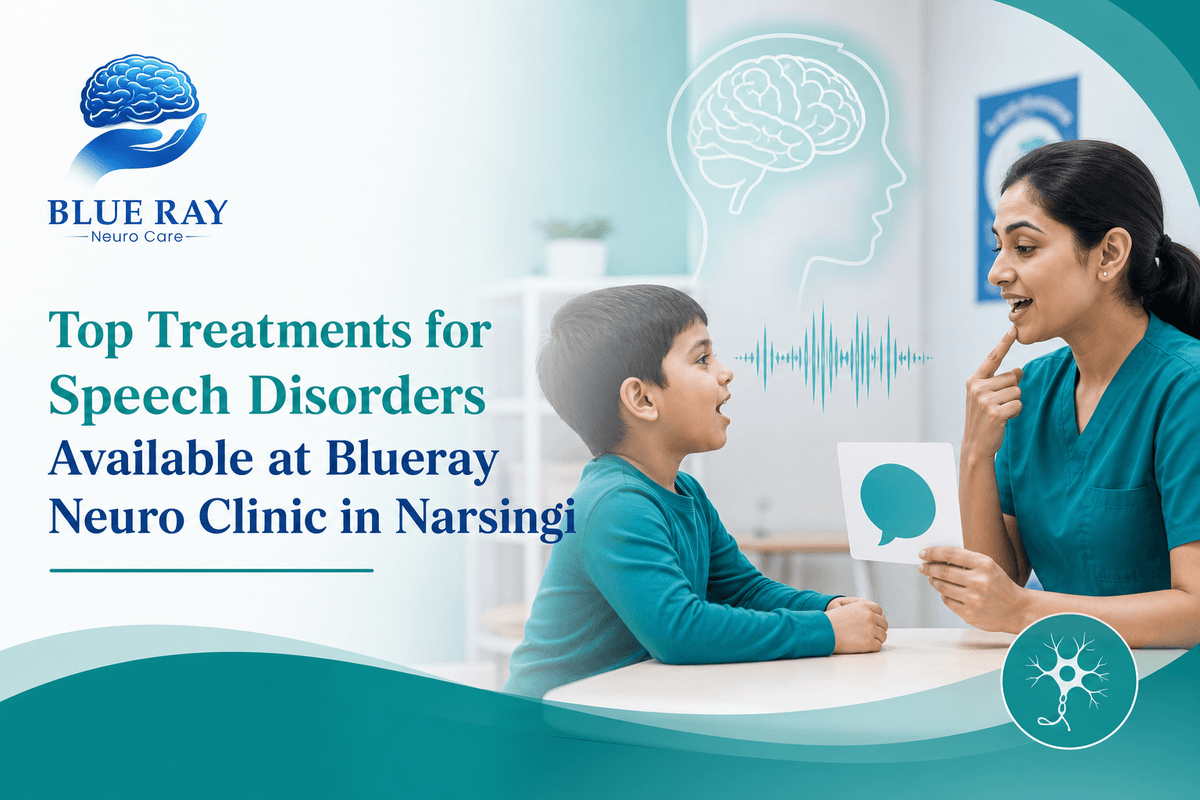
Top Treatments for Speech Disorders Available at Blueray Neuro Clinic in Narsingi
Expert Neurological Care for Aphasia, Dysarthria, Apraxia & More — Right Here in Narsingi
When Words Fail: The Silent Struggle of Speech Disorders
Picture this: a father in Narsingi who survived a stroke three months ago can no longer hold a conversation with his family. He knows what he wants to say — the thoughts are clear — but the words simply will not come out right. Or a young child whose parents have noticed she still is not speaking clearly at age four, while other children her age are forming complete sentences.
These are not isolated situations.
Speech and language disorders can be caused by a variety of factors, including genetic conditions, hearing loss, developmental delays, brain injuries, or neurological disorders.
Degenerative neurological diseases affect several cellular processes, including balance, mobility, and speech.
Aphasia alone occurs in approximately 30–40% of stroke survivors, and communication disorders are common after moderate-to-severe traumatic brain injury.
For families in Narsingi and surrounding areas, navigating this challenge without specialist support can feel overwhelming. The good news: effective, evidence-based treatments are available closer than you think — at Blueray Neuro Clinic in Narsingi.
The Direct Answer: What Causes Neurological Speech Disorders?
Neurological speech disorders in adults include aphasia, dysarthria, apraxia, and conditions linked to diseases like Parkinson's and multiple sclerosis. Symptoms range from slurred speech and word-finding difficulty to inconsistent speech errors and reduced facial expression. Strokes, traumatic brain injuries, neurodegenerative diseases, MS, brain tumors, infections, genetic disorders, and epilepsy can all cause speech or language disorders.
Understanding the specific type of disorder is the critical first step. They are not all the same:
- Aphasia —
a disorder that results from damage (usually from a stroke or traumatic brain injury) to areas of the brain responsible for language.
- Dysarthria —
a motor speech disorder where damage to the nervous system causes the muscles that produce speech to become paralyzed or weakened, making it difficult to control the tongue or voice box and causing slurred words.
- Apraxia of Speech —
a neurological disorder that affects the brain pathways involved in planning the sequence of movements involved in producing speech. The brain knows what it wants to say, but cannot properly plan and sequence the required speech sound movements.
Neurological disorders can have a profound impact on a person's ability to communicate, often leading to various types of speech impairments. From aphasia resulting from a stroke to dysarthria caused by cerebral palsy, these conditions can drastically alter an individual's speech patterns and overall quality of life.
The Solution: Treatments Available at Blueray Neuro Clinic, Narsingi
At Blueray Neuro Clinic in Narsingi, the approach to speech disorders is rooted in accurate neurological diagnosis first — because treatment must match the root cause. Patients from across Narsingi benefit from a comprehensive, multi-modal care plan tailored to their specific condition.
1. Neurological Evaluation & Diagnostic Imaging
Before any therapy begins, our neurologist conducts a thorough assessment.
Depending on medical history and symptoms, diagnostic tools may include studies of the head and neck using X-rays, CT scans, or MRI scans
to identify the area of neurological involvement driving the speech problem.
2. Structured Speech-Language Therapy (SLT)
Treatment typically includes training to compensate for deficiencies, patient and family education, at-home exercises, and neurological rehabilitation to address impairments due to medical conditions, illnesses, or injury.
For dysarthria specifically,
treatment focuses on managing symptoms through compensatory strategies and adaptive techniques, including helping patients slow their speech rate, implementing breath-support training, exercising speech muscles to maintain function, and teaching communication strategies to maximize intelligibility.
3. Intensive Aphasia Rehabilitation
Speech and language therapy aims to improve the ability to communicate by restoring as much language as possible, teaching how to compensate for lost language skills, and finding other methods of communicating.
Therapy often begins within days of stroke; early stimulation supports brain healing, and more intensive therapy builds structured language skills.
4. Augmentative & Alternative Communication (AAC)
Some patients benefit from augmentative and alternative communication (AAC) devices when speech becomes too difficult.
Our team at Narsingi guides families in selecting and using appropriate tools, ensuring patients remain communicators even during recovery.
5. Family Counselling & Caregiver Training
Recovery is strongest when communication partners understand how to help. Speech-language pathologists teach families and caregivers how to reduce frustration and promote independence.
At Blueray Neuro Clinic, caregiver education is a standard part of every treatment plan.
6. Medication-Assisted Management
For conditions like Parkinson's disease, spasmodic dysphonia, or MS-related speech changes,
medical treatment for conditions that cause speech problems, such as Parkinson's disease, may reduce the effect on speech
when combined with structured therapy.
The Evidence: Why Early, Intensive Treatment Works
The science behind speech recovery is both encouraging and clear — but it demands timely action.
Neuroplasticity is fundamental to speech and language recovery after stroke or TBI.
The process primarily relies on the brain's capacity for neuroplasticity — the ability to rewire and form new neural connections to compensate for damage.
Research consistently shows that starting speech therapy as early as medically safe — often within days to weeks after a stroke — leads to the strongest outcomes in communication, cognition, and swallowing.
Children who begin speech therapy before age 5 are up to twice as likely to achieve age-appropriate communication skills.
For adults,
with good therapy and time, speech disorders can often improve significantly.
Therapy intensity plays a measurable role. Research supports higher-frequency sessions — two to three times per week — over once-weekly visits, especially for motor-based disorders like apraxia and articulation issues.
Early detection of speech impairments resulting from neurological disorders plays a critical role in managing these conditions. Regular check-ups, particularly for individuals with known neurological issues, can facilitate early identification of changes in speech patterns.
At Blueray Neuro Clinic, Narsingi, every treatment protocol is built around these evidence-based principles — intensive, early, and personalised.
Frequently Asked Questions (FAQ)
Q1. What is the most common neurological cause of speech disorder in adults?
Stroke is the most common cause of acquired neurological speech disorders in adults.
Among patients with acquired disorders of communication, 66% had aphasia, 35% dysarthria, and 26% apraxia of speech, with mean age of 59 years and stroke as the most frequent cause at 71%.
If you or a family member experiences sudden speech changes, seeking a neurologist immediately is critical.
Q2. Can speech disorders be fully cured with treatment?
Recovery varies by disorder type and timing of treatment.
Recovery can continue for months or even years. While some individuals fully recover, others improve significantly but may retain mild language differences.
The key predictor of outcome is how early and how intensively treatment is started.
Q3. Is it a neurologist or a speech therapist I should see first for speech problems?
See a neurologist first to identify the underlying cause.
If your speech disorder is due to a stroke or head injury, you'll first be seen by a doctor who specialises in disorders of the nervous system (neurologist), and may eventually be referred to a speech-language pathologist for rehabilitation.
At Blueray Neuro Clinic in Narsingi, both neurological diagnosis and coordinated speech rehabilitation are managed under one roof.
Q4. Are speech disorders in children always neurological?
Not always, but neurological causes are significant.
Language and speech delay has a prevalence of 2.7 per 1,000 children in India
, and can arise from developmental, genetic, or neurological origins.
Early intervention is crucial in improving outcomes, though some individuals may require ongoing support.
Parents in Narsingi noticing delayed or unclear speech in their child should consult a neurologist without delay.
Q5. Where in Narsingi can I get a neurological evaluation for a speech disorder?
Residents of Narsingi and nearby areas can visit Blueray Neuro Clinic in Narsingi for a comprehensive neurological evaluation of speech disorders. The clinic provides expert diagnosis, structured therapy planning, and ongoing management for conditions including aphasia, dysarthria, apraxia, and speech problems linked to Parkinson's disease, stroke, and other neurological conditions — all within Narsingi, eliminating the need to travel to distant city centres for specialised neurological care.
Medically reviewed content. This blog is for informational purposes only and does not substitute for professional medical advice. Always consult a qualified neurologist for diagnosis and treatment.
Visit Us
Visit Blueray Neuro Clinic for trusted, compassionate care. We're here for you and your family.
Blueray Neuro Clinic
Narsingi
Phone: +917981370703
Website: www.bluerayneurocare.com
Google Maps: https://maps.app.goo.gl/KLP9djKQcbzV3Wqt6
Email: drpriyanka@bluerayneurocare.com