

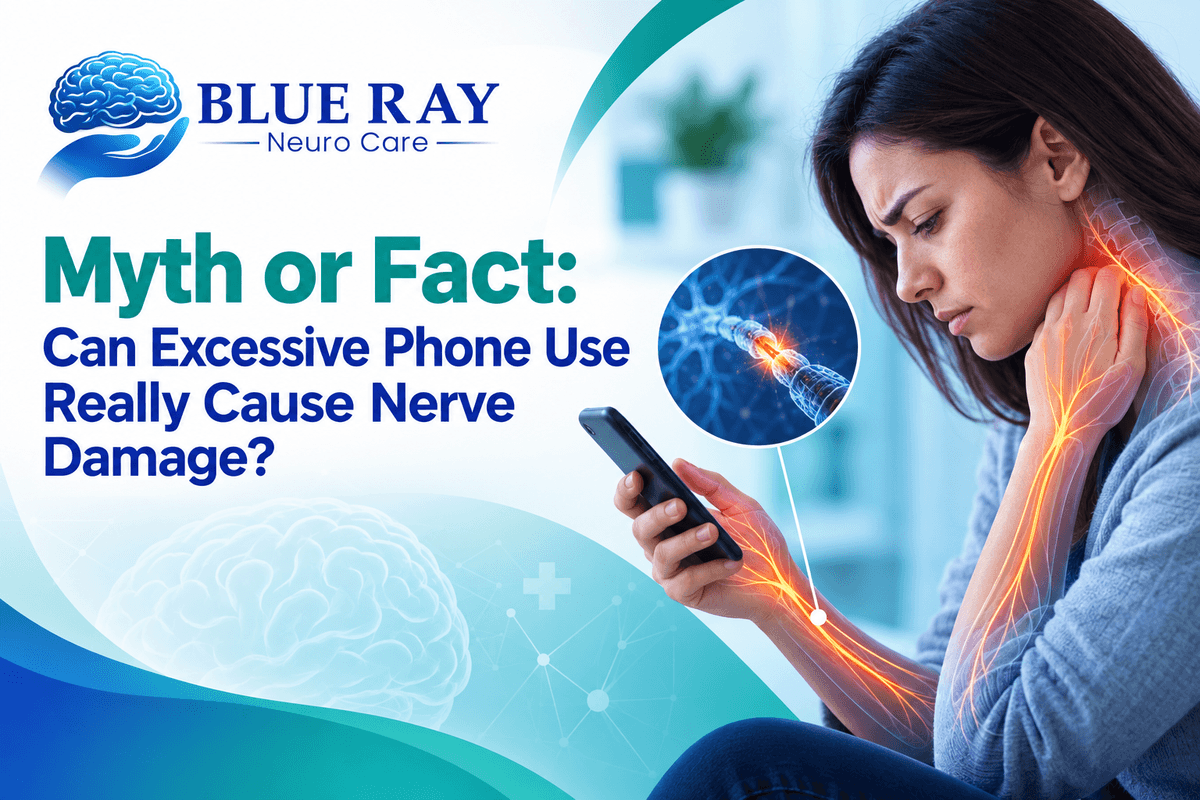
Myth or Fact: Can Excessive Phone Use Really Cause Nerve Damage?
By Blueray Neuro Clinic | Neurologist in Narsingi, Hyderabad
The Problem: That Tingling in Your Fingers Isn't Just "Nothing"
You scroll through Instagram before bed. You hold your phone to your ear for long calls. You tap out messages on WhatsApp for hours. And lately, you've noticed something odd — a numb little finger, a persistent tingle in your wrist, or a nagging ache that shoots from your neck down to your hand.
You brush it off. You blame it on stress, or a bad sleeping position. But what if your smartphone is the actual culprit?
This is a question patients across Narsingi and surrounding areas of Hyderabad are increasingly asking their doctors. With screen time at an all-time high and more people working, studying, and socialising entirely on handheld devices, neurological complaints linked to phone use are rising — and most people have no idea this is even possible.
So let's settle this once and for all: Is "phone-related nerve damage" a myth — or a growing medical fact?
The Answer: It's Very Much a Fact — and the Science Backs It Up
Excessive smartphone use can absolutely cause real, measurable nerve damage. This isn't alarmist — it's biology.
Indians are now spending an average of five hours daily on their smartphones, and India ranks third globally in daily mobile screen time. That's five hours of sustained pressure on nerves, tendons, and spinal structures — every single day.
Here is what the research confirms is actually happening inside your body:
1. Cubital Tunnel Syndrome ("Cell Phone Elbow") When users flex the elbow to hold the phone near the ear, this results in increased pressure over the ulnar nerve since the ulnar nerve runs superficially at the level of the elbow. The extensive pressure over the ulnar nerve may result in nerve compression, which results in cubital tunnel syndrome — recently called "cell phone elbow." In a published nerve conduction study, seventy percent of subjects reported tingling and numbness during mobile phone usage. There was also a significant positive correlation between the duration of mobile phone use and nerve conduction latency, and a negative correlation with conduction velocity — meaning the longer the phone use, the slower the nerve signal.
2. Carpal Tunnel Syndrome (Median Nerve Compression) Carpal tunnel syndrome, resulting from median nerve compression, is prevalent among smartphone users who engage in repetitive wrist and finger movements. Research confirms that the incidence of CTS strongly correlates with smartphone use for 2 hours or longer daily.
3. Text Neck & Cervical Nerve Damage Text neck can contribute to long-term degenerative changes in the spinal column, including damage to the spinal nerves and cervical disks. When you look down at your phone, you can place up to 60 pounds of force on your cervical spine. Over time, text neck can worsen, causing cervical curvature alteration, posterior ligamentous injury, and entrapment neuropathies.
4. Brain-Level Changes Excessive digital device use has been linked to neuropsychological effects, including disruptions in brain network connectivity that are important for cognitive control and higher-order processing. A 2024 study found that excessive screen time was associated with structural variations in brain regions involved in cognitive and emotional processing, including the thalamus, prefrontal cortex, and brainstem.
The verdict is clear: this is not a myth. Nerve damage from excessive phone use is documented, progressive, and — if caught early — treatable.
The Solution: Expert Neurological Care Right Here in Narsingi
If you're experiencing any numbness, tingling, shooting pain, weakness in your fingers, or unexplained neck and arm pain, you don't need to travel to Banjara Hills or Jubilee Hills to get answers. Blueray Neuro Clinic in Narsingi brings specialist neurological expertise directly to residents of Narsingi and the surrounding communities of Kokapet, Manikonda, and Puppalaguda.
Here's how our clinic approaches phone-related nerve conditions:
Step 1 — Comprehensive Neurological Evaluation Our neurologist conducts a detailed clinical examination to identify which nerve is affected — the ulnar nerve at the elbow, the median nerve at the wrist, or the cervical nerve roots in the neck. No guesswork; just precise diagnosis.
Step 2 — Nerve Conduction Studies (NCS) & Electromyography (EMG) These gold-standard diagnostic tests measure how fast your nerves are conducting electrical signals. A significant positive correlation has been established between the duration of mobile phone use and nerve conduction latency, so these tests tell us exactly how much damage, if any, has occurred.
Step 3 — Personalised Treatment Plan Depending on severity, your plan may include ergonomic counselling, posture correction, splinting, targeted physiotherapy referral, or medication to reduce nerve inflammation. In advanced cases, surgical decompression options are discussed and coordinated.
Step 4 — Lifestyle & Prevention Guidance We help you restructure your smartphone habits so that nerve compression doesn't return. This is especially important for IT professionals, students, and business owners in Narsingi who depend heavily on their devices for work.
Early intervention makes all the difference. If compression is not relieved, the damage to the ulnar nerve may become irreversible, leading to long-term functional impairment of the hand. Don't wait until it gets to that point.
The Evidence: What the Research and Data Tell Us
The clinical case for seeking neurological evaluation is compelling:
Young adults, particularly university students, are disproportionately affected, with over 50% of heavy smartphone users reporting hand pain or dysfunction.
Carpal tunnel syndrome is the most common peripheral nerve compression disorder, impacting nearly 3.8% of the general population.
Cubital Tunnel Syndrome is the second-most common compressive neuropathy of the upper limb, traditionally associated with prolonged elbow flexion. With the widespread adoption of smartphones, sustained upper-limb postures have emerged as potential novel risk factors for ulnar nerve compression.
Research concludes that excessive mobile phone use enlarges the median nerve, causes thumb pain, and decreases pinch strength and hand function — highlighting mobile phone addiction's association with median nerve changes and impaired hand function.
The human spine is a kinematic chain with all joints interconnected, meaning changes from increased head tilt while texting can have significant effects on the entire spine. A 2023 study showed an increase in spinal curvature, particularly in the cervical region, as smartphone use time increased.
The good news? When patients seek care before the nerve damage becomes structural, outcomes are excellent. At Blueray Neuro Clinic, residents of Narsingi have access to the diagnostic tools and specialist knowledge needed to catch these conditions early and reverse their course.
Frequently Asked Questions (FAQ)
1. Can using my phone really cause permanent nerve damage?
Yes, it can — if ignored for too long. Tech neck is a pattern of cervical spine injury caused by sustained forward head posture during smartphone or screen use, producing chronic overload on the neck muscles and accelerated disc degeneration. What begins as muscle tightness can progress, over months and years, to structural nerve damage that requires active medical intervention. Early diagnosis is key to avoiding permanent damage.
2. What are the warning signs that phone use has affected my nerves?
Watch out for numbness or tingling in your little and ring fingers (ulnar nerve), numbness in the thumb and first two fingers (median nerve), neck pain radiating into your arm, or weakness when gripping objects. If a cervical nerve becomes pinched, pain and possibly neurological symptoms can radiate down your arm and into your hand — known as cervical radiculopathy. Any of these symptoms warrant a neurologist consultation.
3. How is phone-related nerve damage diagnosed?
A neurologist will first conduct a physical examination, followed by a Nerve Conduction Study (NCS) or Electromyography (EMG) if needed. The compression of the median nerve in the carpal tunnel compromises the blood-nerve barrier, resulting in edema, inflammation, and fibrosis of the adjacent connective tissues. The subsequent stage involves disruption of the myelin sheath of the nerve followed by damage to the axon — all of which can be identified through these tests before symptoms worsen.
4. Is nerve damage from phone use reversible?
In most early-stage cases, yes. Reducing phone use, correcting posture, using splints, and following a neurologist-guided treatment plan can allow nerves to recover. However, if compression is not relieved, damage to the nerve may become irreversible, leading to long-term functional impairment. This is why residents of Narsingi experiencing any persistent tingling or numbness should not delay getting evaluated.
5. Where can people in Narsingi get tested for phone-related nerve conditions?
Residents of Narsingi — including nearby localities like Kokapet, Manikonda, Tellapur, and Puppalaguda — can visit Blueray Neuro Clinic in Narsingi for a specialist neurological consultation. Our neurologist provides on-site nerve conduction studies and personalised treatment plans, so you don't have to commute across the city for quality neurological care. If you're spending more than 3–4 hours daily on your phone and have started noticing tingling, weakness, or neck-to-arm pain, scheduling an evaluation at your earliest is the smartest step you can take.
Visit Us
Visit Blueray Neuro Clinic for trusted, compassionate care. We're here for you and your family.
Blueray Neuro Clinic
Narsingi
Phone: +917981370703
Website: www.bluerayneurocare.com
Google Maps: https://maps.app.goo.gl/KLP9djKQcbzV3Wqt6
Email: drpriyanka@bluerayneurocare.com