

Now I have all the data I need to write the complete blog post. Let me compose it.
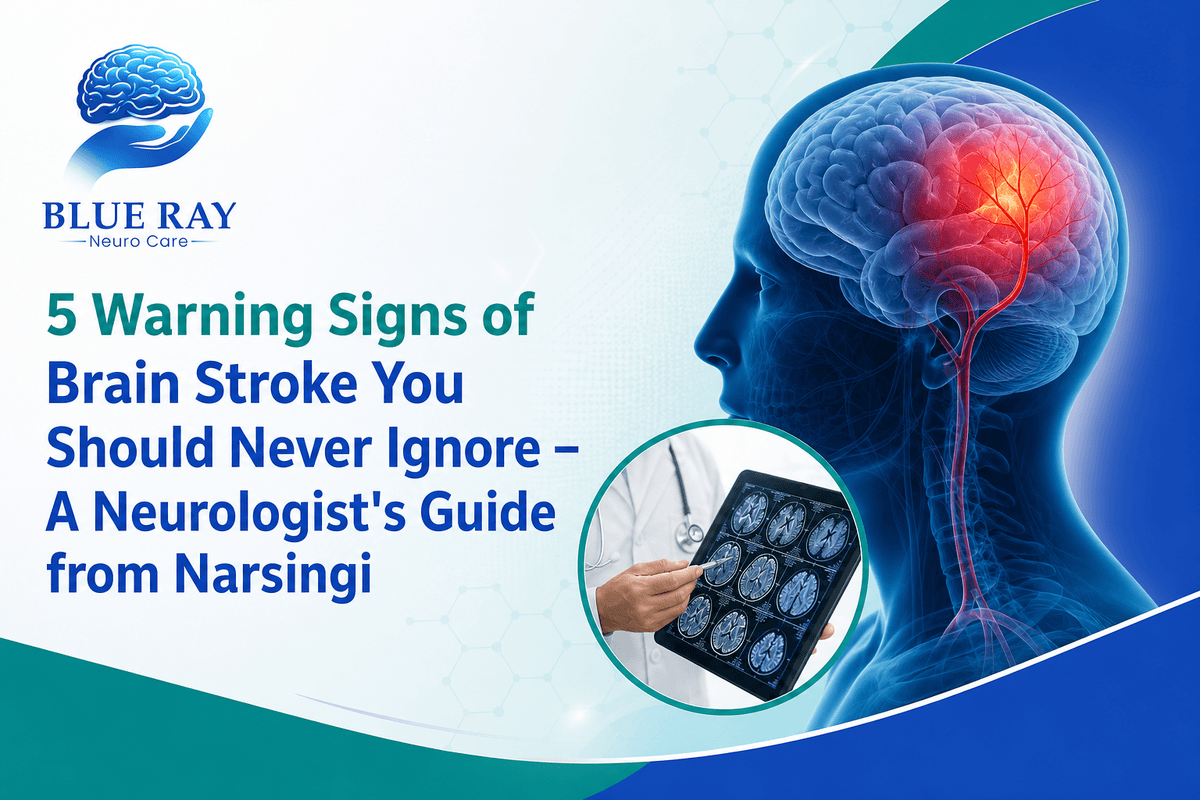
5 Warning Signs of Brain Stroke You Should Never Ignore – A Neurologist's Guide from Narsingi
Every Second Counts: Are You Missing the Signs of a Stroke?
Imagine sitting down for dinner with your family in Narsingi, and suddenly your hand goes numb. You brush it off — "probably the way I was sitting." Or you notice one side of your face feels strange, but you assume it's just tiredness from a long day at the office. These are the moments that can change a life forever.
Stroke has emerged as a formidable health challenge in India, with its incidence on the rise — driven by increasing risk factors like hypertension, diabetes, obesity, sedentary lifestyle, and alcohol intake.
What makes this crisis especially alarming is that
its impact on young adults — a pivotal segment of India's workforce — is particularly worrisome.
The tragedy is not just that strokes happen. The tragedy is that the warning signs are often dismissed, delayed, or simply not recognized.
For every minute a stroke goes untreated, the brain loses 1.9 million cells.
At Blueray Neuro Clinic in Narsingi, we see this pattern repeatedly — patients who waited, hoping the symptoms would pass. This guide exists so that doesn't happen to you or someone you love.
What Is a Brain Stroke and Why Does It Happen So Fast?
A stroke occurs when blood flow to a part of the brain is interrupted, either due to a blocked artery (ischemic stroke) or a ruptured blood vessel (hemorrhagic stroke).
Acute Ischemic Stroke is the most common type — caused by obstruction of cerebral arteries, leading to brain tissue damage due to lack of oxygen. When this happens, brain cells begin to die within minutes.
Stroke ranks as the fourth leading cause of death and the fifth leading cause of disability in India. The incidence of stroke in India ranges from 119 to 145 per 100,000 population annually, with a higher prevalence observed in urban areas.
Ischemic strokes are the most common, accounting for about 70–80% of all strokes, while hemorrhagic strokes make up the remaining 20–30%.
The good news? Most strokes are preventable, and all strokes are treatable — but only if you act fast. The five warning signs below are your body's distress signals. Learn them now.
The 5 Warning Signs of Brain Stroke You Should Never Ignore
⚠️ Warning Sign #1: Sudden Facial Drooping or an Uneven Smile
One of the most visible and reliable signs of a stroke is a sudden droop on one side of the face. Ask the person to smile — if their smile appears uneven, crooked, or only one side of the face moves, it is a red flag.
Facial drooping or an uneven smile on one side
is a hallmark symptom recognized by the Indian Stroke Association in its national awareness campaigns. Do not wait to see if it "resolves on its own."
⚠️ Warning Sign #2: Sudden Arm or Leg Weakness on One Side
Sudden arm or leg weakness on one side of the body
is another critical warning sign. Ask the person to raise both arms straight out in front of them. If one arm drifts downward or cannot be lifted at all, it strongly suggests a stroke is occurring.
As per the American Heart Association's FAST framework: Arm Weakness means asking an individual to hold both arms straight up — look to see if one arm drifts down slowly or cannot be lifted. Time means calling for medical help immediately and reaching the hospital within 4.5 hours of the onset of symptoms.
⚠️ Warning Sign #3: Sudden Slurred or Garbled Speech
Slurred or garbled speech
— where the person cannot form clear words or repeat a simple phrase — is one of the clearest indicators of stroke. The person may also be unable to understand what you are saying to them, even though they appear awake.
A stroke happens when the flow of blood to a specific part of the brain is blocked or reduced, leading to sudden loss of function such as difficulty in speaking, facial deviation, loss of limb movement, vision problems, dizziness, or imbalance.
Any one of these appearing suddenly demands immediate action.
⚠️ Warning Sign #4: Sudden Vision Problems or Double Vision
Many patients in Narsingi ignore sudden vision disturbances, assuming they are just dehydrated or haven't slept enough. This is a dangerous mistake.
Sudden blurred or double vision in one or both eyes
is a recognized stroke warning sign. A stroke affecting the visual cortex or the pathways controlling eye movement can cause blackouts in part of your visual field, sudden double vision, or complete loss of vision in one eye — all within seconds.
⚠️ Warning Sign #5: Sudden Loss of Balance or Unexplained Dizziness
Sudden loss of balance or unexplained dizziness
— especially when accompanied by any of the other four symptoms listed here — is a serious neurological emergency. It can be mistaken for inner-ear problems or low blood pressure, but when it appears without warning, a stroke must be ruled out immediately.
The BE-FAST acronym used in clinical settings adds B (Balance) and E (Eyes) to the classic FAST signs precisely because these symptoms are so frequently overlooked.
🚨 Remember the BE-FAST rule: Balance · Eyes · Face · Arms · Speech · Time. If you see any of these signs, note the time symptoms began and get to a stroke-ready hospital immediately.
How Blueray Neuro Clinic in Narsingi Helps You Respond to Stroke
At Blueray Neuro Clinic, Narsingi, our neurologist provides rapid, structured stroke evaluation for patients across Narsingi and surrounding areas including Manikonda, Kokapet, Puppalaguda, and Nanakramguda.
When a patient arrives with suspected stroke symptoms, our approach follows evidence-based protocols:
- Rapid Clinical Assessment using the NIHSS (National Institutes of Health Stroke Scale) to grade severity
- Urgent Brain Imaging — CT or MRI scan to differentiate ischemic from hemorrhagic stroke and guide treatment
- Timely Thrombolysis Pathway —
the golden hour refers to the critical window — ideally within 60 minutes, at most within 4.5 hours — during which treatment for an ischaemic stroke is most effective.
- Stroke Risk Factor Management — identifying and controlling hypertension, diabetes, and cardiac conditions that drive recurrence
- Personalized Post-Stroke Rehabilitation Planning for patients requiring long-term recovery support
We also provide preventive neurology consultations for patients with high-risk profiles — including those with a history of hypertension, diabetes, atrial fibrillation, or prior TIA (mini-stroke) episodes. Residents across Narsingi no longer need to travel far for expert neurological care; advanced stroke evaluation is now available right here in your neighbourhood.
Why the Evidence Demands You Act — Not Wait
In stroke medicine, there is a phrase every neurologist lives by: "Time is brain." For every 60 seconds untreated, a patient loses approximately 1.9 million brain cells, 13.8 billion synapses, and 12 kilometres of nerve fibres.
The difference between arriving at hospital in 30 minutes versus 3 hours can mean the difference between walking out independently or permanent disability.
Consider the scale of the problem in India alone:
-
In 2019, there were 535,700 incident stroke cases in India, marking a 118.8% increase from 1990.
-
Hypertension makes up 60.8% of stroke risk factor cases, diabetes mellitus accounts for 35.7%, and cigarette smoking for 32.2%.
-
Among ischemic stroke patients, 16.7% were between 18 and 45 years old.
This last statistic is perhaps the most sobering. Stroke is no longer an "old person's disease." The working-age population of Narsingi — IT professionals, business owners, homemakers — is increasingly at risk.
A transient ischemic attack (TIA) is often called a mini-stroke, but it's really a warning stroke. TIA and stroke symptoms are the same, although most TIA symptoms last only a few minutes. While TIAs generally do not cause permanent brain damage, they are major warnings and should not be ignored.
About one-third of people who have a TIA go on to have a more severe stroke within a year.
If you or someone in your family has experienced even a brief episode of these symptoms — seek a neurologist in Narsingi immediately. A TIA is your brain giving you a second chance.
Frequently Asked Questions (FAQ)
Q1. What is the fastest way to identify a stroke at home?
Use the BE-FAST test immediately. Check for sudden Balance loss, Eye/vision changes, Face drooping, Arm weakness, and Speech difficulty.
If you see any of these signs, call an ambulance and reach a stroke-ready hospital. Note the time symptoms began — time saved is brain saved.
Do not drive the patient yourself; call emergency services.
Q2. Can a young and healthy person have a stroke?
Yes — and rates among young adults are rising.
Particularly worrisome is the impact on young adults, a pivotal segment of India's workforce.
There is a rising incidence in younger adults under 55 years due to smoking, obesity, and lifestyle changes.
Anyone with uncontrolled blood pressure, diabetes, or a sedentary lifestyle is at risk, regardless of age.
Q3. What happens if a stroke is not treated within the golden hour?
Delayed treatment significantly worsens outcomes.
The longer brain stroke treatment is delayed, the more chance of major deficits, and the greater the probability those deficits will be permanent. The first 60 minutes after the onset of stroke symptoms are known as "the golden hour."
Modern treatments like thrombolysis and thrombectomy are transforming stroke care, but they require timely action.
Q4. Is Blueray Neuro Clinic in Narsingi equipped to manage stroke emergencies?
Yes. Blueray Neuro Clinic, located in Narsingi, offers specialist neurology consultations with rapid stroke assessment and imaging referral pathways. Patients from Narsingi, Manikonda, Kokapet, Puppalaguda, and Nanakramguda can access prompt expert neurological evaluation without traveling to the city centre. Early evaluation at a dedicated neurology clinic is the most important step after recognizing symptoms.
Q5. What is a TIA or "mini-stroke," and should I see a neurologist after one in Narsingi?
Absolutely — a TIA is a medical emergency, not something to monitor at home.
A transient ischemic attack (TIA), often referred to as a "mini-stroke," is a stroke that lasts only a few minutes, caused when the blood supply to part of the brain is briefly blocked.
Most symptoms of a TIA happen suddenly and usually go away within an hour. There is no immediate way to tell whether symptoms are from a TIA or a stroke — that's why it is important to get emergency medical care right away.
If you live in Narsingi or surrounding areas and experience even brief stroke-like symptoms, consult a neurologist at Blueray Neuro Clinic the same day.
This article is written for patient education purposes by the neurology team at Blueray Neuro Clinic, Narsingi. It does not substitute for a medical consultation. If you or someone near you experiences any stroke warning signs, call emergency services immediately.
Visit Us
Visit Blueray Neuro Clinic for trusted, compassionate care. We're here for you and your family.
Blueray Neuro Clinic
Narsingi
Phone: +917981370703
Website: www.bluerayneurocare.com
Google Maps: https://maps.app.goo.gl/KLP9djKQcbzV3Wqt6
Email: drpriyanka@bluerayneurocare.com